André has cooked in some of the most demanding kitchens in the world. He is not interested in reproducing them. He is interested in what they taught him about intention, discipline, and the relationship between a cook and a place.
He grew up in a family where the table was the centre of everything. Food was never a backdrop. It was the occasion itself, the reason people gathered, the thread that held the hours together. That has never left him.
He spent eleven years at The Ritz-Carlton Dining Room in San Francisco, one of the most formally rigorous kitchens in the country, rising to Sous Chef under Ron Siegel. The standard he built there, in technique, in service, in the invisible architecture of how an evening unfolds, defines everything he designs today.
He later cooked a season at noma in Copenhagen, while it was ranked the best restaurant in the world. It was an environment where every received idea about food was examined and usually discarded. He came back to California with a different relationship to the land in front of him. The farmers, ranchers and foragers he works with now are not suppliers. They are collaborators.
Since 2013 he has brought that foundation into private homes, estates and retreats across the Bay Area and Napa Valley. The work is quiet and specific. He does not take many engagements, and he designs the ones he takes with complete attention.
When you sit at a table André has built, it does not feel like a restaurant moved into a house. It feels like an evening that could only have happened here, with these people, on this night.
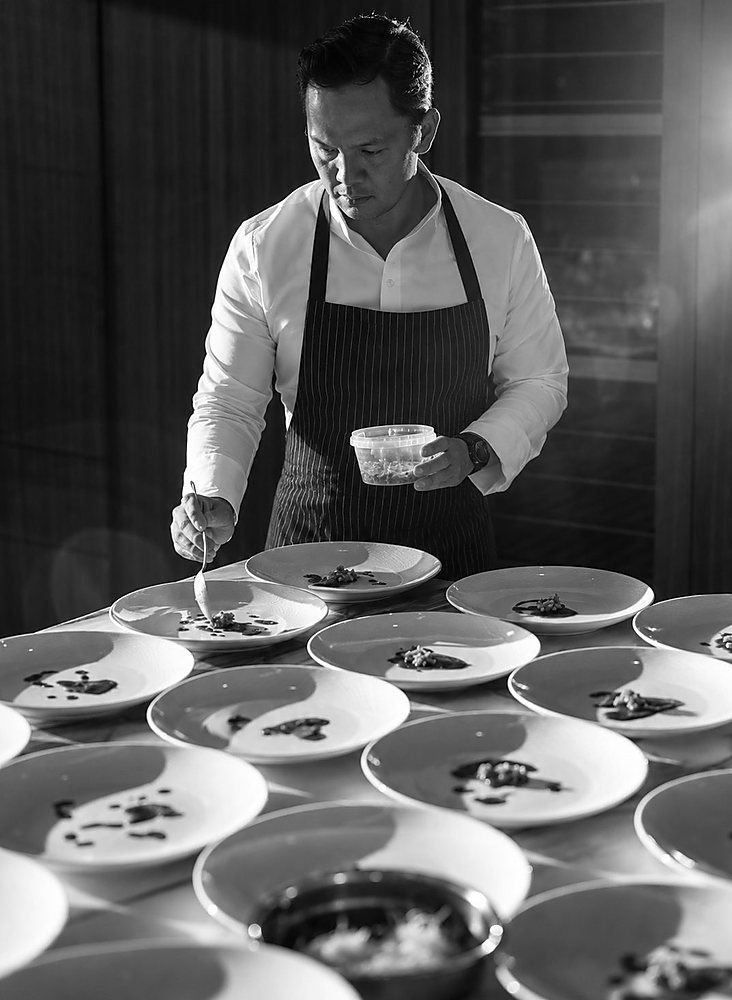
A path through kitchens
Each place left something specific. Not credentials to list, but ways of thinking about food and the people it is made for.
The Ritz-Carlton Dining Room
San Francisco. Eleven years in one of the most formally demanding fine dining kitchens in the country, rising to Sous Chef under Ron Siegel. He learned not only how to cook at that level, but how to build a meal that earns a guest's trust from the first course to the last.
noma
Copenhagen. A season on the line while it was ranked the best restaurant in the world. He returned with a radically different relationship to Northern California's own terroir, its farms, its seasons and its coastline. The influence shows in how he sources and composes, without being worn on the sleeve.
Private practice
Bay Area and Napa Valley, since 2013. The move out of restaurants was deliberate. He wanted to design evenings for particular people in particular places rather than send the same menu into a room of strangers.
Now
A small number of engagements each year across intimate dinners, executive gatherings, estate events and household residencies. Each one designed from the beginning. Nothing templated, nothing repeated.
The meal should feel inevitable.
André believes the best private dinner is one that could not have happened anywhere else, for anyone else, on any other night. Not because it is showy. Because it is specific.
He works only with produce he respects, from people he knows, and designs only for occasions he understands. He does not compromise on either.
Questions
What is André Villahermosa's background?
He has cooked professionally since 2000, including eleven years at The Ritz-Carlton Dining Room in San Francisco where he rose to Sous Chef under Ron Siegel, and a season at noma in Copenhagen while it was ranked the best restaurant in the world. He founded his own private practice in 2013.
Who did André train under?
Ron Siegel at The Ritz-Carlton Dining Room in San Francisco, where he spent eleven years and worked up to Sous Chef.
What does he cook?
Seasonal California French, garden to plate. Menus are built around what is ripe that week and the wines being poured, and no menu is repeated.
How many engagements does he take?
A small number each year. He accepts selectively so that every evening can be designed from the beginning with complete attention.